-
 Australia
 Hong Kong SAR
 Indonesia
 Malaysia
 New Zealand
 Philippines
 Singapore
 United States
 United Arab Emirates
 Vietnam




Copyright © 2026 Powered by BCI Media Group Pty Ltd




Notification
Select Country
Confirm Submission
Are you sure want to adding all Products to your Library?
Contact Detail
21 Nov 2025 by Satu Bumi


Choosing precast concrete planter boxes for commercial landscaping projects is easy, right? Well, maybe not as easy as it looks! But since planter boxes usually form a long term and highly visible element of most commercial building or landscaping projects, it’s important to get your planter box decision right. Let’s have a look at five things you should take into consideration.
Commercial buildings are designed to last at least twenty years before requiring significant refurbishment. The investment economics simply don’t make sense otherwise. Therefore, it stands to reason that the substantial elements of a commercial building landscaping or patio scaping should also be expected to stay intact, functional and reasonably appealing for at least a similar time frame. So, you need to choose planter boxes that are going to last. However, most planter boxes don't last!
Planter Boxes can be made from a seemingly endless array of different materials such as clay, plastics, fiberglass, metals, stone, wood, blockwork and a wide variety of composites. And if made well, planter boxes from any of these materials can look great. But are they suitable for long term commercial projects when you consider the following:
To be blunt, none of these materials really stack up as an ideal raw material for the construction of long-term planter box solutions for outside commercial projects. So why use them? Alternatively, GRC (Glassfibre Reinforced Concrete) is fundamentally concrete with all the long-lasting attributes that have made concrete one of the most popular and adaptive building materials for literally thousands of years. So, expecting GRC planters to last for twenty years is not too big an ask!
Concrete has been such a tremendously successful building material because it has great compressive strength, weather resistance and can be easily moulded to virtually any architectural shape. But planter boxes need more than that. This is where the GRC technology comes into play. Glassfibre reinforcement adds flexural and tensile strength which are essential elements in the construction of concrete planter boxes. And the practical result is that GRC planter boxes will last!
Planter box suppliers are either manufacturers or resellers of manufacturers’ products. Both supply channels have their advantages and disadvantages. Either one could be suitable for your requirements so let’s broadly summarise the key differences to minimise any confusion when you are talking with multiple potential planter box suppliers.
Resellers typically:
Resellers can be good supply options if you are looking for fast delivery of relatively small to medium sized planter boxes, relatively small quantities of a planter box shape or you have little interest in tailored planter box solutions.
A word of warning: By the very nature of a reseller's position in the market it is the role of a middleman. This is a valuable role in linking buyers to manufacturers, but it is a service that comes with a layer of cost that is usually accounted for by either an increase in the reseller's sales prices or a reduction in the quality of their products. To avoid this issue, there are some resellers that promote their businesses in terms of "cutting out the middleman" to imply that if you buy from them, you are buying directly from the factory. However, if they are not actually the manufacturer or a middleman it is difficult to understand what they actually are. Therefore, at least that part of their promotional material should be considered questionable.
Manufacturers typically:
Hold limited stock
but can readily produce whatever quantity is required
Commercial projects often specify tailored sizes in different standard shapes such as narrow trough planters, tall square planters, cylinder planters, rectangle planters, square planters or even specialised architectural shapes, which are generally not available off the shelf from a reseller. Therefore, unless compromise is an option, a manufacturer will need to be involved either directly or through a reseller with a manufacturer.
The all-inclusive term “GRC Manufacturer” covers several different types of manufacturers. Therefore, it may also be worthwhile having a broad understanding of the difference between the main ones.
Although GRC manufacturers are not all the same, you can find a good GRC planter box supplier from any of the above categories. However, being able to categorise your potential suppliers will better prepare you to assess their suitability for your GRC planter projects.
Manufacturers have a lot of distinct advantages over resellers. However, it shouldn’t come as too much of a shock to hear that not all GRC manufacturers are good GRC manufacturers.
So, what do you need to do? Well, if you want to deal directly with a planter box manufacturer, the key is to find one that is committed to the use of quality raw materials and industry recognised manufacturing standards. The document on GRC manufacturing standards called “Specification for the Manufacture, Curing & Testing of Glassfibre Reinforced Concrete (GRC) Products” from The International Glassfibre Reinforced Concrete Association (GRCA) is an excellent summarised guide to the standards that are applicable to the manufacture of good GRC.It goes without saying that price will always be a factor in any commercial purchase. But when you are sourcing GRC planters be careful not to mix up the concept of price with value. There are plenty of war-stories of cheap GRC planters that have completely fallen apart or cracked because of poor quality raw materials or poor manufacturing practices. Be aware that not all GRC is good GRC.
If a manufacturer cannot show a commitment to the use of quality raw materials and recognised manufacturing process standards, then move on and find another manufacturer. It’s as simple as that. GRC is easy to make but good GRC is not and there should be no tolerance given on this issue if you are expecting to source GRC planters that last. There is no doubt that I am going to put Satu Bumi forward as a trustworthy manufacturer but there are also other GRC manufacturers that supply into the Australian market that do a good job. You just need to avoid the "GRC Cowboys" that cut corners to reduce manufacturing costs and there are plenty of them.
It goes without saying that price will always be a factor in any commercial purchase. But when you are sourcing GRC planters be careful not to mix up the concept of price with value. There are plenty of war-stories of cheap GRC planters that have completely fallen apart or cracked because of poor quality raw materials or poor manufacturing practices. Be aware that not all GRC is good GRC.
When GRC planters cost less than the opposition there is generally a reason, and you need to be careful it is not simply because of cost cutting from high volume producers. As you could imagine, when there are multiple layers of distribution between a manufacturer and yourself there are also the same multiple layers of on-cost. Therefore, to keep the end price competitive when re-sellers are involved, manufacturers at the front end of supply chains are under great pressure to keep their manufacturing costs down. This is often reflected in the poor quality of their products.
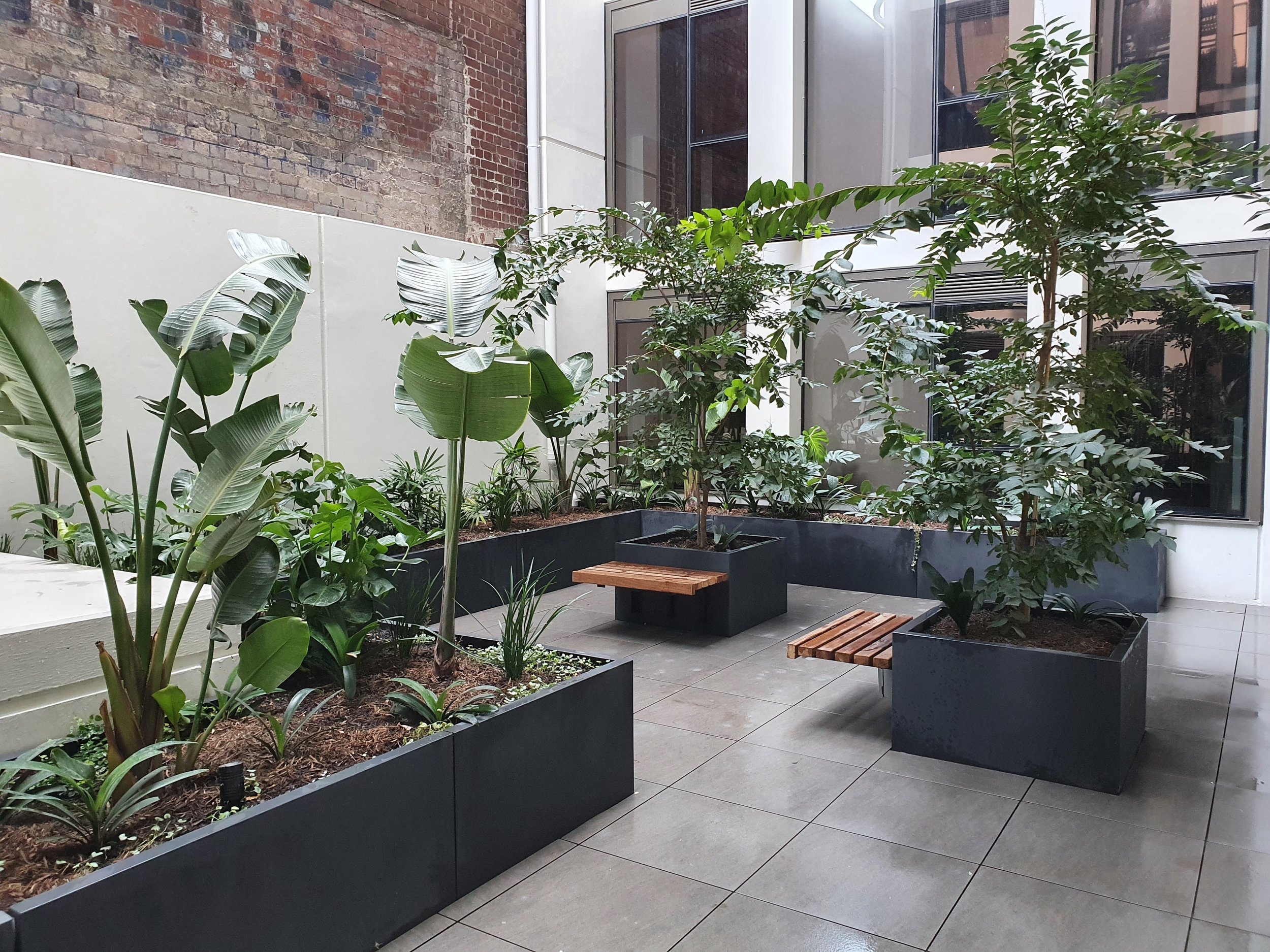
The most valuable piece of advice you will ever find on the web about sourcing GRC planter boxes for commercial projects is to choose your GRC manufacturer carefully whether you are sourcing GRC planters through a re-seller or directly from the manufacturer.